



How to Start a Home Cleaning Business: A Step-by-Step Guide for Beginners
If you’re wondering how to start a home cleaning business, here’s the truth: you do not need a degree, a fancy office, or investors.
You need:
- A plan
- Basic equipment
- Legal structure
- Discipline
Cleaning is one of the lowest barrier-to-entry service businesses. The demand is constant. People are busy. Dual-income households are rising. Elderly homeowners need help. Property managers need turnovers.
I have seen weekend side hustles turn into six-figure operations in under three years. But only when the foundation was built correctly.
- A plan
- Basic equipment
- Legal structure
- Discipline
This guide walks you through the legal, financial, operational, and marketing steps required to do this professionally.
No shortcuts. No confusion.
Phase 1: Planning & Niche Selection (Laying the Groundwork)
Before you buy a mop, you need clarity.
Generalist vs. Specialist
Not all cleaning businesses are the same.
Residential Cleaning (Recurring)
- Weekly or bi-weekly homes
- Stable recurring revenue
- Predictable schedule
Deep Cleaning
- One-time intensive service
- Higher pricing
- Often first-time clients
Move-Out / Move-In Cleaning
- Real estate driven
- Property managers are key contacts
- Fast-paced, deadline-sensitive
Eco-Friendly / Organic Cleaning
- Uses non-toxic supplies
- Appeals to families with kids, pets, or allergies
- Premium pricing potential
If you’re just starting, recurring residential cleaning is the most stable foundation. It builds recurring revenue, which is the heartbeat of long-term survival.
Choose your niche based on:
- Local competition
- Average household income
- Demand in your area
Researching Your Local Market
You do not guess pricing.
You study it.
Search local cleaning companies in your city. Call pretending to be a customer. Ask for quotes.
Evaluate:
- Their pricing model
- Their service packages
- Their online reviews
- Their professionalism
Document everything. This becomes your competitive positioning.
This step alone prevents underpricing, which kills most beginners.
Phase 2: The Legal Stuff (Making It Official)
This is where amateurs hesitate. Professionals do not.
Choosing a Business Structure: LLC vs Sole Proprietorship
Let’s simplify this.
Sole Proprietorship
- Easiest to start
- No legal separation between you and the business
- You are personally liable
If something goes wrong, your personal assets are exposed.
LLC (Limited Liability Company)
- Creates legal separation
- Protects your personal assets
- More credible
If you plan to grow or hire, LLC is usually the smarter long-term choice.
Register through your local government portal. Do not skip this step.
Insurance and Bonding
Read this carefully:
Do not step into a client’s home without insurance.
You need:
- General Liability Insurance – covers accidental damage
- Bonding – protects clients from theft concerns
- Workers’ Compensation (if hiring employees)
Being bonded and insured builds trust immediately. Many higher-income clients will not hire uninsured cleaners.
This is not optional.
Licensing and Permits
Requirements vary by city and state.
Check:
- Local business licensing office
- State government websites
- Tax registration requirements
Handle it properly once. Avoid penalties later.

Phase 3: Tools of the Trade (Equipment & Supplies)
You don’t need commercial machinery on day one.
Start lean.
Startup Essentials (Cleaning Business Equipment List)
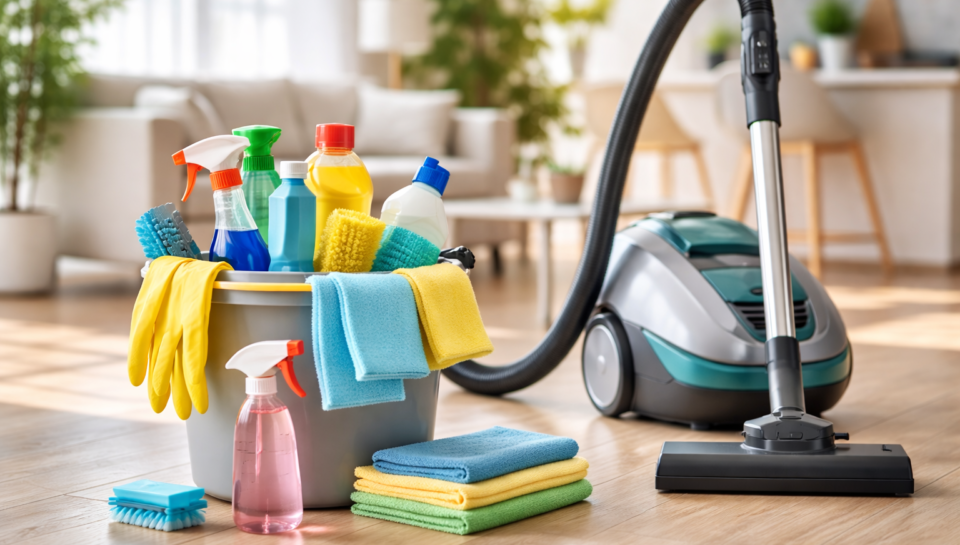
Equipment:
- Reliable vacuum
- Mop and bucket
- Microfiber cloths
- Duster
- Scrub brushes
- Spray bottles
Supplies:
- All-purpose cleaner
- Glass cleaner
- Bathroom disinfectant
- Floor cleaner
- Gloves
- Trash bags
Understand this clearly:
Supplies are consumables. Equipment is long-term investment.
Keep receipts. Track expenses. These matter for taxes.
Expansion Upgrades
Once revenue stabilizes:
- Commercial-grade vacuum
- Steam cleaner
- Eco-friendly product line
- Branded uniforms
- Vehicle signage
Upgrade only when revenue justifies it.

Phase 4: Pricing Your Services (How to Get Paid)
Most beginners panic here.
Relax. There is a formula.
Hourly vs Flat-Rate Pricing
Hourly Rate
- Easier to calculate initially
- Transparent
- Less predictable profit margins
Flat-Rate Pricing
- Based on size and condition
- More professional
- Encourages efficiency
Most established companies move toward flat-rate pricing.
How to Price Cleaning Services (Simple Formula)
Use this formula:
Cost of Labor + Cost of Supplies + Overhead + Profit Margin = Final Price
Example:
- Labor: $20/hour x 3 hours = $60
- Supplies: $5
- Overhead (insurance, gas, admin): $15
- Desired profit: $30
Total = $110
Never price emotionally.
Never price based on desperation.
Handling Quotes and Scope of Work
Define your scope of work clearly:
- What is included
- What is excluded
- Additional fees for add-ons (oven, fridge, interior windows)
Always inspect before giving firm quotes.
Written estimates protect you from misunderstandings.
Phase 5: Finding Your First Clients (Marketing on a Shoestring)
You do not need expensive ads.
You need consistency.
Low-Cost Digital Marketing
- Create a Google Business Profile
- Set up a simple Facebook page
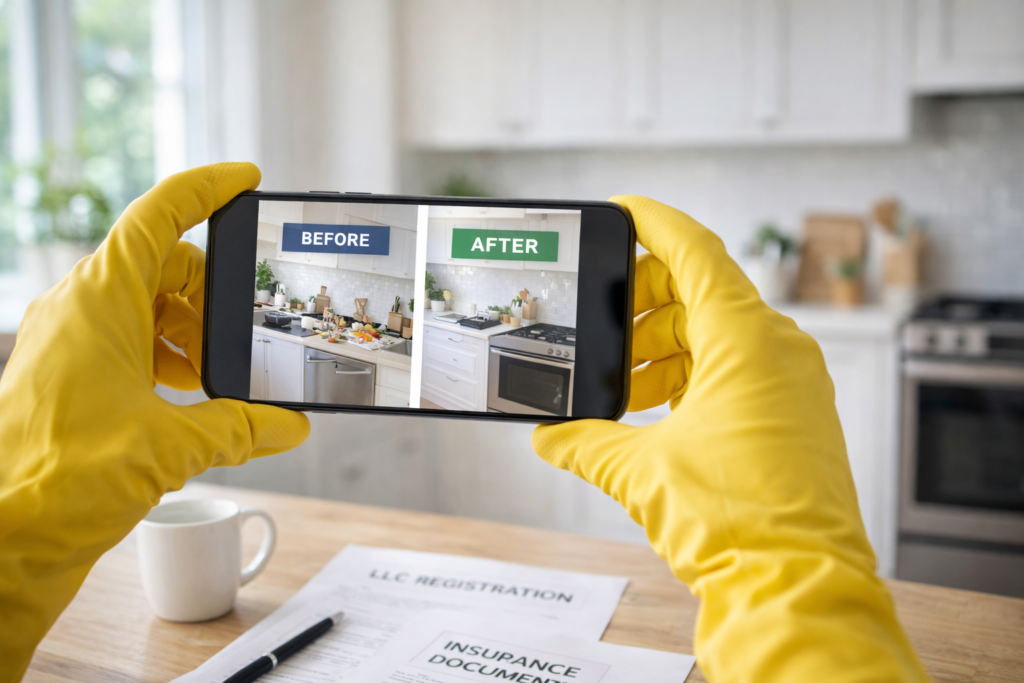
- Post before/after photos
- Ask for reviews immediately
Reviews build credibility faster than ads.
When people search “cleaning near me,” visibility matters.
Offline Marketing
Do not underestimate physical presence.
- Flyers in targeted neighborhoods
- Door hangers in middle-income areas
- Partnerships with real estate agents
- Community bulletin boards
Target homeowners, not apartment complexes initially.
The Referral Engine
Your first 5 clients are your marketing department.
After successful service, ask directly:
“I’m growing my business. If you’re happy with my work, I’d truly appreciate a review or referral.”
Client retention is cheaper than constant new acquisition.
Recurring clients = stability.
Phase 6: Systems for Scaling (Beyond the Mop)
This is where you separate from hobbyists.
Implement systems early.
- Scheduling software (Jobber, Housecall Pro, etc.)
- Digital invoices
- Written service agreements
- Clear cancellation policies
Professional systems reduce stress and increase perceived value.
If you want to hire in the future, document your cleaning processes now.
Create checklists.
Standardize quality.
Scaling without systems leads to chaos.
Cleaning Business Startup Costs
Realistically, you can start between:
- $300 – $1,500
Breakdown:
- Equipment & supplies: $200–$600
- Registration & licensing: varies
- Insurance: $300–$800 annually
- Basic marketing: $100–$300
Do not overspend at launch.
Cash flow is oxygen.
Start a Cleaning Business Checklist
Before accepting your first client, ensure:
- Business registered
- Insurance active
- Pricing structure defined
- Cleaning business equipment list completed
- Scope of work documented
- Basic marketing presence live
- Payment method set up
Operate like a company from day one.
Conclusion
Starting a cleaning company is not glamorous.
It is disciplined work.
You:
- Plan carefully
- Legalize properly
- Equip intelligently
- Price strategically
- Market consistently
That is how you build stability.
The demand exists. Homes will always need cleaning.
The difference between dreamers and owners is execution.
The demand is there. All you need to do is take the first step today.
FAQ
Do I need a license to clean houses?
In many cities, yes. Requirements vary. Check your local business registration office. Even if not legally required, registering increases credibility.
How much money do I need to start a cleaning business?
You can realistically begin with $300–$1,500, depending on insurance and registration costs. Keep overhead low initially.
How do I handle a client who won’t pay?
First, ensure you have a written agreement and clear payment terms. Send a formal reminder. If ignored, issue a written demand notice. For larger amounts, consider small claims court. Prevention is better than recovery. Always define payment terms upfront.