
How to Move Heavy Furniture Safely
Moving heavy furniture often looks easy until the item gets stuck in a doorway, tips near a corner, or scratches the floor. The job becomes even more stressful when you…
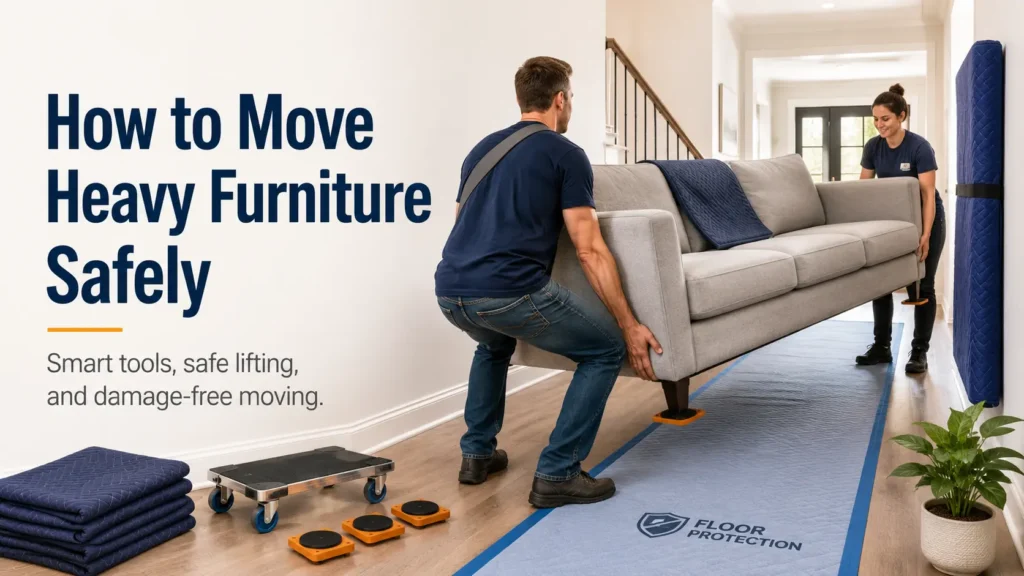
Moving heavy furniture often looks easy until the item gets stuck in a doorway, tips near a corner, or scratches the floor. The job becomes even more stressful when you live alone, have limited help, or need to move a couch, dresser, table, or appliance through stairs and narrow halls. You may also worry about hurting your back, damaging a wall, losing part of your security deposit, or choosing the wrong tool for the job.
After researching furniture-moving methods, professional safety guidance, equipment instructions, and real problems shared by renters and homeowners, I found that the hardest part is not always the weight. It is keeping the furniture stable and controlling it through tight spaces. The safest approach is to empty and disassemble the item, measure the full route, protect the floor and walls, and use equipment suited to the furniture and surface. This guide explains how to move heavy furniture safely, which tools to use, and when professional help is the better choice.
You may be:
- Rearranging furniture inside your home
- Moving into or out of an apartment
- Loading a rental truck
- Picking up secondhand furniture
- Moving without professional movers
- Working with limited help
- Trying to keep moving costs low
The right plan can make the job safer and easier.
To move heavy furniture, empty and take apart the item first. Measure the furniture and the full moving route. Protect the item, floors, doors, and walls. Then, use the correct equipment.
You may need:
- Furniture sliders
- A furniture dolly
- A hand truck
- An appliance dolly
- Lifting straps
- Moving blankets
- Tie-down straps
Do not rush. Stop if the item starts to tip, slide, or become hard to control.
The safest method depends on:
- The furniture’s size and weight
- The shape and balance of the item
- The type of floor
- The number of helpers
- The length of the route
- Whether stairs are involved
- Whether the item can be taken apart
For example, sliders may be enough to move a low dresser across one room. However, a refrigerator going down stairs may require an appliance dolly and trained help.
Use this quick guide to choose a moving method:
Choose the Safest Moving Method
Match the furniture, floor, and route with the most suitable moving method.
| Situation | Suggested Method |
|---|---|
| Heavy furniture across hardwood | Clean felt-bottom sliders |
| Heavy furniture across carpet | Smooth plastic carpet sliders |
| Wide item on a level route | Four-wheel furniture dolly |
| Tall item on a level route | Secured hand truck |
| Refrigerator or washing machine | Appliance dolly and manufacturer instructions |
| Large furniture on stairs | Stair-rated equipment and capable helpers |
| Piano, safe, or slate pool table | Specialist mover |
| No helpers available | Delivery or labor-only moving help |
Safety note: Furniture size, weight, stability, floor type, and route may change the safest method.
Key Takeaways
- Empty and disassemble furniture before moving it.
- Measure the item, doors, hallways, stairs, and elevator.
- Use sliders on level floors and dollies on flat, clear routes.
- Use stair-rated equipment when moving furniture on steps.
- Protect floors, walls, doors, and furniture before starting.
- Do not move tall, unstable, or specialty furniture alone.
- Stop if the load shifts, tips, or becomes hard to control.
- Hire trained movers for pianos, safes, stone tops, and difficult stairs.
Plan Ahead & Clear Your Path
Good planning can prevent injuries and property damage.
First, trace the route from the furniture’s current position to its new location or the moving truck.
Look for anything that may block the path, including:
- Rugs
- Shoes
- Boxes
- Lamps
- Pet toys
- Electrical cords
- Wet areas
- Poor lighting
- Narrow corners
- Uneven floors
- Raised thresholds
Remove these hazards before you begin. Keep children and pets away from the moving area.
If you are moving into or out of an apartment, check the building rules. Some buildings require you to:
- Reserve the elevator
- Use a service elevator
- protect elevator walls
- Reserve a loading area
- Move during set hours
- Use insured movers
- Provide advance notice
Check these rules before moving day.
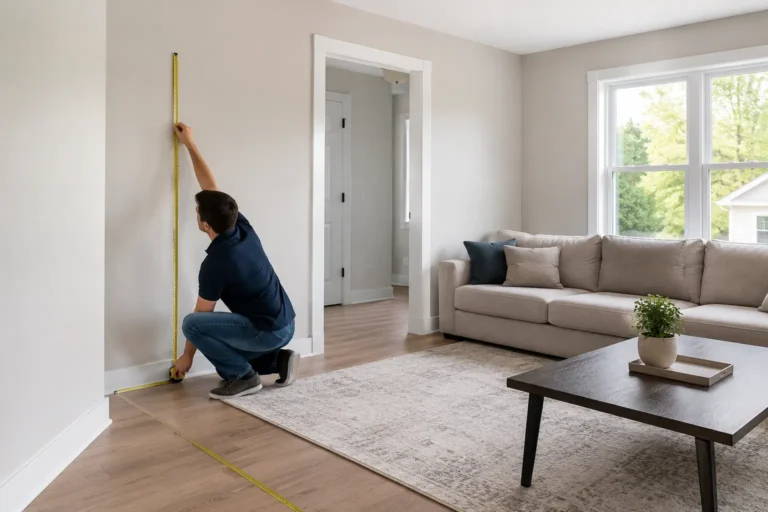
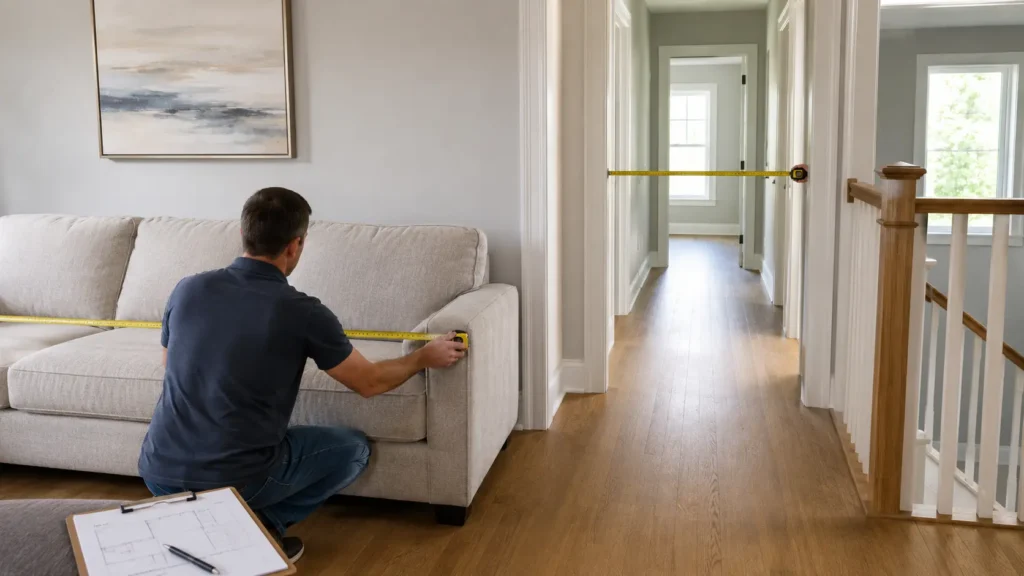
Next, measure the furniture. Record its height, width, and depth. Measure it again after removing legs, drawers, shelves, or cushions.
You should also measure:
- Door openings
- Hallways
- Stairways
- Stair landings
- Elevator doors
- Elevator interiors
- Truck doors
- Ceiling height near stair turns
Do not assume the furniture will fit. A couch may pass through a doorway at an angle but still fail to turn inside a narrow hallway.
Check every tight corner before lifting. Decide which side of the furniture should enter first.
If you are buying used furniture, measure the item before pickup. Ask the seller for exact measurements. You should also measure your vehicle, doorway, elevator, and staircase.
Do not depend only on photos. Furniture may look smaller online than it is in real life.
Inspect the furniture too. Look for:
- Loose legs
- Damaged panels
- Cracked wood
- Broken handles
- Weak joints
- Loose glass
- Missing hardware
Never lift furniture by a decorative or damaged part.
Finally, decide whether the move is safe to handle yourself. Large, unstable, or top-heavy items should not be moved alone. Stairs increase the danger.
A low dresser moving across one clean floor is different from a large couch going up three flights of stairs. Do not treat both jobs as equal.
Gather the Right Moving Equipment
The correct equipment can reduce lifting and help you control the furniture.
Useful moving tools include:
- Furniture sliders
- Furniture dollies
- Hand trucks
- Appliance dollies
- Lifting straps
- Moving blankets
- Stretch wrap
- Tie-down straps
- Packing tape
- Work gloves
- Floor runners
- Basic hand tools
Choose each tool based on the furniture, floor, and route.
Furniture sliders
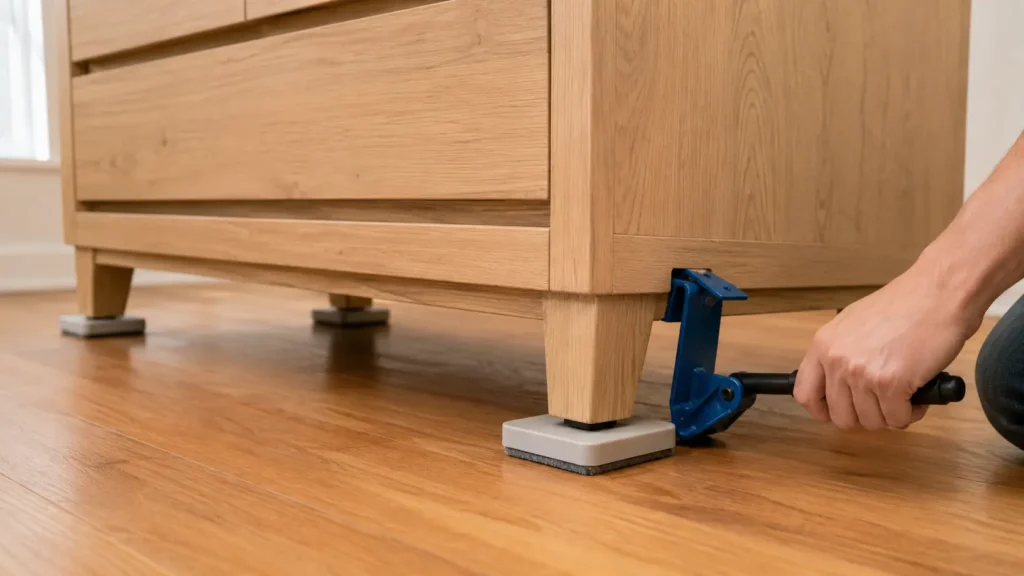
Furniture sliders work well for short moves across level floors. They reduce friction between the furniture and the surface.
Felt-bottom sliders are often used on clean hardwood, laminate, or vinyl. Smooth plastic sliders are often used on carpet.
Always check the product label. Some sliders are made for only one floor type.
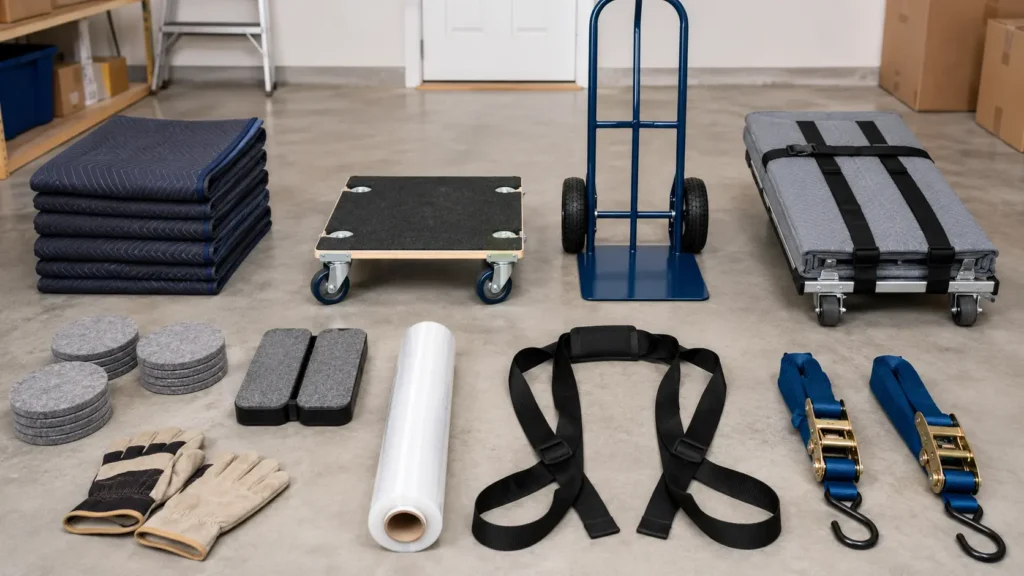
Sliders may be useful when you:
- Rearrange furniture in one room
- Move a couch away from a wall
- Clean under a dresser
- Move a table across the same floor
- Have limited lifting ability
Sliders make furniture easier to move. However, they do not prevent tall furniture from tipping.
Furniture dolly
A furniture dolly has a flat platform and four wheels. It works best for wide and stable furniture on a level route.
A standard furniture dolly should not be used on stairs.
It may work well for:
- Low cabinets
- Tables
- Desks
- Packed boxes
- Stable dressers
- Some sofas
Make sure the furniture fits fully on the platform.
Hand truck
A hand truck has two wheels and a tall frame. It can help move tall furniture or stacked items.
Secure the load with the correct strap before moving.
A hand truck may work for:
- Tall boxes
- Some bookcases
- Small cabinets
- Packed storage bins
- Certain narrow furniture pieces
Do not use a hand truck when the item cannot be secured or balanced.
Appliance dolly
An appliance dolly is designed for large appliances. It often has strong straps and added support.
It may be used for:
- Refrigerators
- Washing machines
- Dryers
- Some large freezers
Follow the equipment instructions and weight limit. Also follow the appliance maker’s moving instructions.
Lifting straps
Lifting straps may help two people carry a large item. They can reduce the need to grip the bottom edge with your hands.
However, straps require:
- Two capable people
- Clear communication
- Correct strap placement
- A clear route
- Similar walking speed
Do not place lifting straps over glass, mirrors, weak panels, or unsupported stone.
Should you buy or rent moving equipment?
Buying may make sense when you:
- Rearrange furniture often
- Own several heavy items
- Expect to move again
- Need sliders for regular cleaning
Renting may make sense when you:
- Need a dolly for one day
- Are completing one local move
- Need an appliance dolly
- Do not have storage space
- Want stronger equipment without buying it
Compare the purchase or rental cost with the cost of hiring help. A low-cost tool is not a good choice when the job is too dangerous for a DIY move.
Check the load limit of every dolly, hand truck, strap, and slider. The equipment must support the furniture’s full weight.
Inspect each tool before use. Check for:
- Cracked wheels
- Flat wheel spots
- Loose handles
- Torn straps
- Damaged buckles
- Cracked sliders
- Dirt trapped in wheels
- Missing parts
Make sure the furniture does not block the operator’s view.
Protect Floors, Walls, & Furniture
Heavy furniture can scratch floors, dent walls, and damage door frames. Protect the full moving route before you begin.
Wrap the furniture with moving blankets. Pay close attention to:
- Corners
- Edges
- Wood trim
- Glass
- Mirrors
- Handles
- Decorative panels
Secure the blankets with stretch wrap or suitable tape.
Do not place strong tape directly on:
- Finished wood
- Leather
- Painted surfaces
- Fabric
- Polished stone
The tape may leave marks or damage the finish.
Protect walls and door frames with:
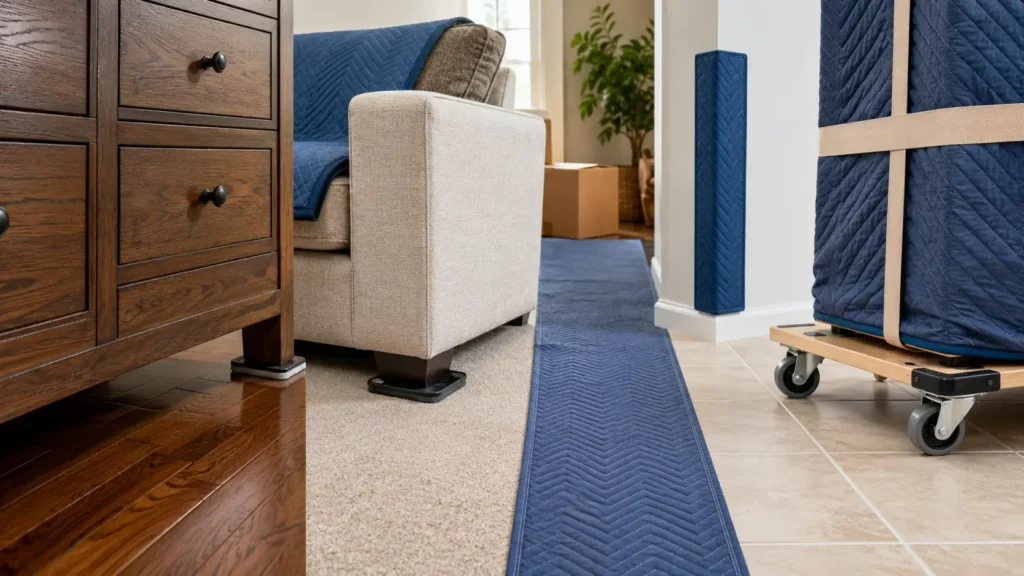
- Corner guards
- Moving blankets
- Foam padding
- Cardboard sheets
Protect every floor surface along the route.
Hardwood, laminate, and vinyl
Sweep or vacuum the route first. Small stones and dirt can become trapped under sliders and scratch the floor.
Use clean sliders made for hard floors. Check the bottom of every slider before placing it under the furniture.
Use floor runners for longer routes.
Do not drag furniture directly across the floor. Scratches may affect the appearance of the home and could reduce a renter’s security deposit.
Carpet
Use sliders designed for carpet. Place each furniture leg near the center of the slider.
Watch for carpet edges and floor transitions. A slider may stop or move out of place.
Tile
Move slowly over grout lines. Avoid dropping heavy weight onto one small area.
Check for cracked or loose tiles before starting.
Floor transitions
Use extra care where:
- Carpet meets hardwood
- Tile meets vinyl
- A doorway has a raised strip
- An elevator has a floor gap
- A ramp meets the ground
A dolly may stop suddenly at a raised threshold.
A moving blanket may protect a floor, but it should not replace a proper slider when it may fold, slip, or make the furniture difficult to control.
Disassemble Furniture
Large furniture is often easier and safer to move after it has been taken apart.
First, empty the furniture. Remove clothes, books, dishes, electronics, and other contents.
This lowers the weight and prevents items from shifting.
Next, remove detachable parts, including:
- Drawers
- Shelves
- Cabinet doors
- Table legs
- Couch legs
- Cushions
- Bed slats
- Bed rails
- Detachable backs
- Glass shelves
- Removable panels
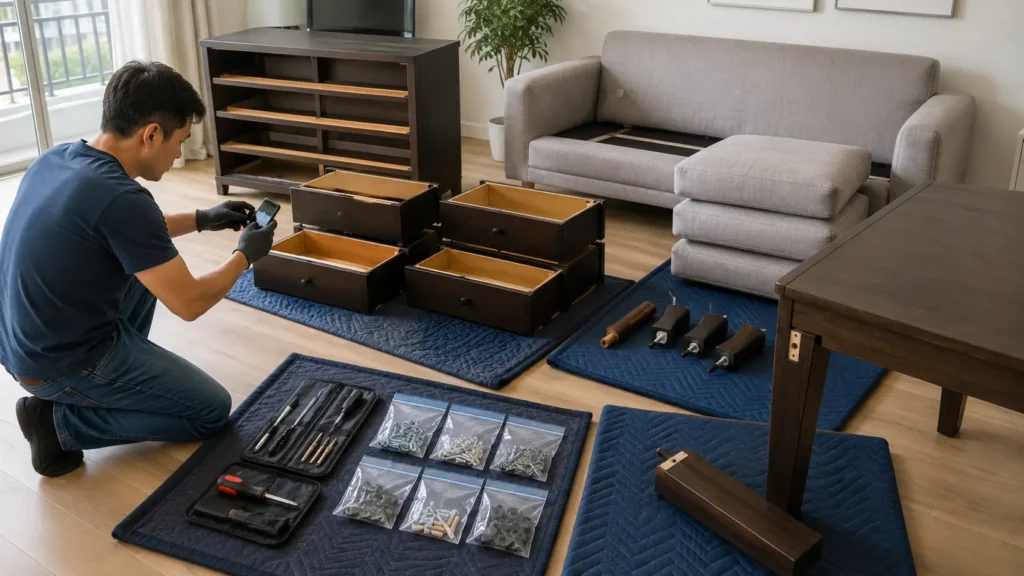
Do not force a part that does not come off easily. Check the furniture manual when possible.
Take photos before and during disassembly. The photos make it easier to rebuild the item later.
Place screws, bolts, washers, and other small parts in a sealed bag. Label the bag with the furniture’s name.
Attach the bag to the wrapped furniture or place it in a marked box. Do not tape it directly to a finished surface.
Secure doors and drawers that cannot be removed. Use stretch wrap or a suitable furniture strap.
Best Moving Method by Furniture Type
Different furniture items need different preparation and equipment. Use this table as a quick guide.
| Furniture Type | Remove First | Suggested Method | Main Risk |
|---|---|---|---|
| Sofa | Cushions and detachable legs | Furniture dolly or two-person straps | Tight turns and weak arms |
| Dresser | Contents and drawers | Sliders or furniture dolly | Tipping |
| Bookcase | Books, shelves, and loose parts | Secured furniture dolly | Top-heavy shape |
| Dining Table | Detachable legs and extensions | Dolly or two-person carry | Weak joints |
| Recliner | Detachable back and loose parts | Furniture dolly | Moving mechanism |
| Refrigerator | Food, shelves, cords, and hoses | Appliance dolly | Tipping and appliance damage |
| Glass Cabinet | Glass shelves and removable panels | Professional help | Glass breakage |
| Piano or Safe | Follow specialist instructions | Specialist movers | Extreme weight |
Safety note: Furniture size, weight, design, and route may change the safest moving method.
Flat-pack and particleboard furniture
Flat-pack and particleboard furniture may not be strong enough to move while fully assembled.
Remove shelves, drawers, doors, and detachable sections when possible.
Do not lift this type of furniture by:
- The top panel
- A thin back panel
- Decorative trim
- A drawer front
- A loose shelf
Large flat-pack furniture may break at its joints during a move.
Glass, mirrors, and stone
Remove glass shelves and panels when the design allows it. Pack them separately.
Do not place lifting straps over unsupported:
- Glass
- Mirrors
- Thin stone
- Decorative panels
Heavy stone-top furniture may require specialist movers.
Appliances
Appliances need extra preparation.
Before moving one:
- Read the manufacturer’s instructions
- Disconnect the power
- Shut off and disconnect water safely
- Use a qualified professional for gas appliances when required
- Drain hoses
- Remove loose shelves and bins
- Secure cords, hoses, and doors
- Follow the manufacturer’s rules about tilting
Do not assume every appliance can be placed on its side.
Wrap and Lift the Furniture
After disassembly, wrap the main furniture frame.
Cover the item with moving blankets. Add extra padding around:
- Sharp corners
- Fragile trim
- Weak areas
- Polished surfaces
- Door frames
Before lifting, choose one person to lead the move.
That person should use short commands, such as:
- “Lift”
- “Stop”
- “Lower”
- “Turn”
- “Step”
- “Set it down”
Make sure everyone understands the commands.
Test the furniture’s weight before making a full lift. Raise one side only a small amount.
If the item feels too heavy, unstable, or hard to hold, lower it.
Do not continue because you feel rushed. Do not risk an injury because you do not want to ask for help.
Stand close to the furniture. Keep your feet apart for balance. Bend at the hips and knees.
Keep the load close to your body. Holding it far away increases strain and makes it harder to control.
Lift in one smooth motion. Use your legs instead of pulling mainly with your back.
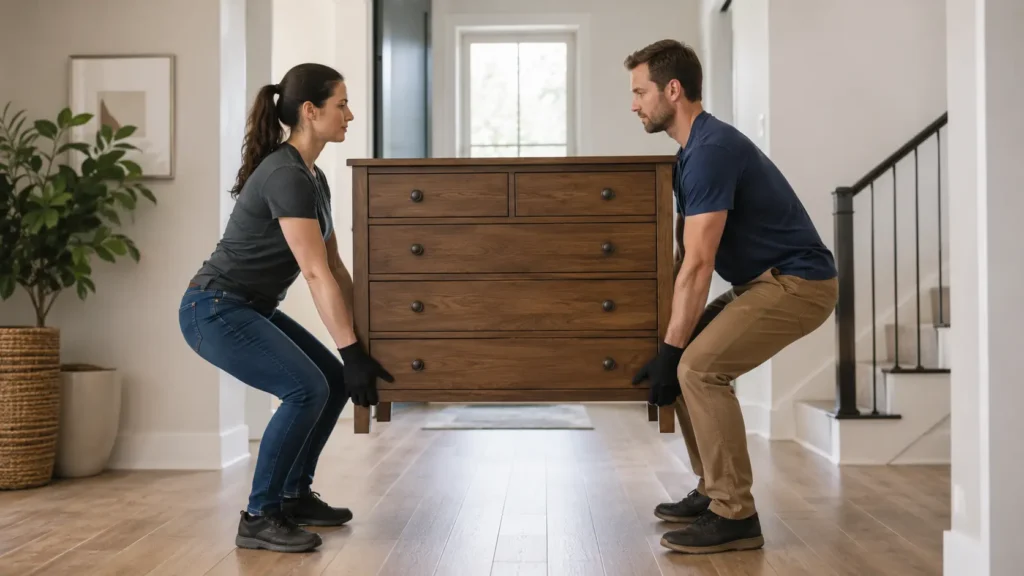
Do not twist while carrying the item. Move your feet when you need to turn.
Keep your hands away from pinch points, including:
- The space under furniture legs
- Door frames
- The area between the furniture and wall
- Dolly wheels
- Stair railings
- Truck doors
Wear closed-toe shoes with non-slip soles.
Gloves may improve your grip. However, gloves do not make an unsafe load safe.
Lower the furniture slowly. Bend your knees and keep your fingers away from the floor.
Use Proper Lifting & Moving Techniques
Good lifting form matters. However, technique alone cannot make every load safe.
You must also consider:
- The furniture’s weight
- Its balance
- The available grip points
- The moving route
- The item’s shape
- The number of helpers
Move slowly and use short steps. Look in the direction you are moving.
If the furniture blocks your view, use a spotter. The spotter should watch for walls, steps, people, pets, and other hazards.
When two people carry a long or tall item, choose positions based on:
- Strength
- Grip
- Visibility
- Balance
- Experience
- The route
Test the load before moving.
On stairs, the person at the lower end may carry more of the weight. Do not continue unless both people can control the item safely.
Do not push a tall dresser, cabinet, or bookcase from the top. It may tip.
Apply force to a strong, lower part of the frame when safe.
Stop immediately when:
- A helper loses their grip
- A strap begins to move
- The furniture starts to tip
- A wheel becomes stuck
- The route becomes blocked
- Someone feels pain
- The load becomes hard to control
Set the furniture down in a safe place. Fix the problem before continuing.
Do not try to catch large falling furniture. Move away and warn everyone nearby.
Coordinate & Communicate Clearly
Clear communication helps everyone move at the same speed.
Before lifting, choose one person to direct the team. This person should have a clear view of the route.
Discuss the plan before touching the furniture.
Everyone should know:
- Where the item is going
- Which side moves first
- Where the tight corners are
- When the group will turn
- Where the item can be set down
- Which commands will be used
Use short and clear instructions. Do not shout several commands at the same time.
Tell the group about any physical limit.
A helper should speak up if they have:
- Back pain
- Joint pain
- Poor grip
- Balance problems
- Trouble seeing the route
- Trouble breathing
- Recent surgery or injury
Take breaks when needed. Tired people are more likely to lose control of a heavy load.
When moving through a doorway, one person should watch each side. Move a few inches at a time.
When using a dolly, one person should control the equipment. Another person can guide the furniture and watch the route.
Never lift or lower the item before everyone confirms they are ready.
Moving Furniture with Sliders
Furniture sliders work best for stable furniture moving a short distance across a level floor.
Common examples include:
- Low dressers
- Tables
- Sofas
- Bed frames
- Desks
- Low cabinets
Use extra caution with:
- Bookcases
- Wardrobes
- Tall cabinets
- Tall dressers
- Narrow storage units
These items may tip even when sliders reduce friction.
Empty tall furniture first. Remove shelves and drawers when possible.
If the furniture is attached to a wall with anti-tip hardware, remove the hardware safely before moving it. Install suitable anti-tip protection after placing the furniture in its new location.
To use sliders:
- Choose sliders made for your floor.
- Empty the furniture.
- Remove loose parts.
- Slightly raise one corner.
- Place the slider under the support point.
- Lower the corner slowly.
- Repeat for the other corners.
- Check that each slider sits flat.
- Push the furniture slowly.
Never place your fingers under unsupported furniture.
Apply pressure to a strong and low part of the frame.
Do not push against:
- Drawer fronts
- Glass doors
- Thin panels
- Handles
- Decorative trim
- Weak joints
Watch each slider as the furniture moves. A slider may slip when crossing a floor seam or threshold.
Stop and reset it when needed.
Do not use standard furniture sliders on stairs.
Navigate Stairs & Tight Spaces Carefully
Stairs make furniture moving much more dangerous.
A large item may slide, tip, or fall. The person at the lower end may carry more of the weight.
Do not move large furniture on stairs alone.
Inspect the staircase first. Remove rugs, decorations, boxes, and other hazards.
Make sure the steps are:
- Dry
- Clear
- Well lit
- Strong enough for the move
Measure:
- Stair width
- Landing size
- Railing height
- Ceiling clearance
- Door openings
- Turning space
Protect railings, walls, corners, and furniture edges with padding.
A standard four-wheel furniture dolly is not designed for stairs.
Use a stair-rated hand truck or appliance dolly only as directed by its manufacturer. Secure the furniture to the equipment before approaching the steps.
Keep everyone out of the fall path. Do not place a person directly below furniture that could slide, tip, or fall.
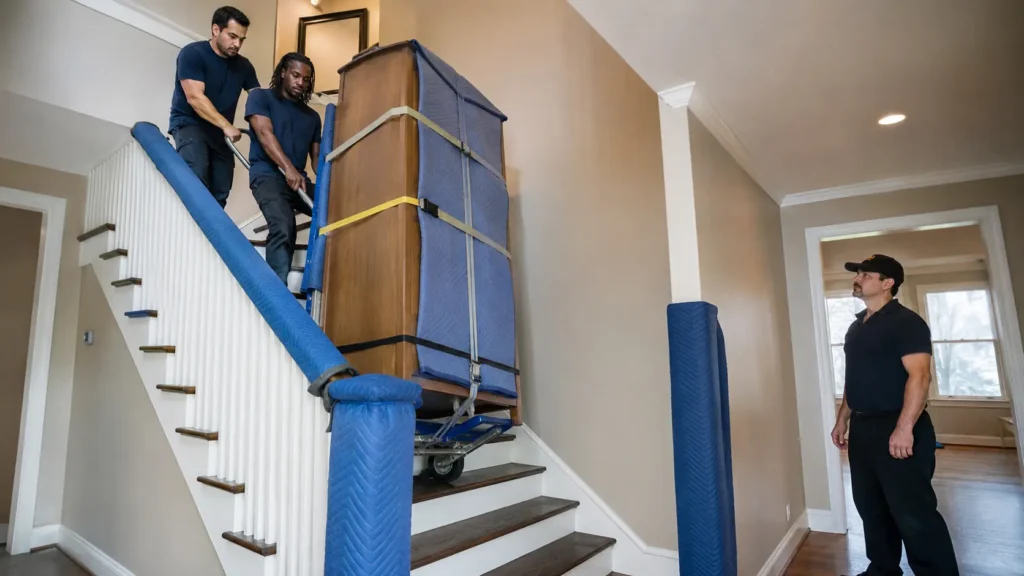
Move one step at a time. The team leader should call each movement.
Do not improvise a stair move with:
- Loose blankets
- Cardboard
- Ropes
- An ordinary flat dolly
- Unrated straps
- Weak boards
If you do not have proper equipment, rent the correct tool or hire trained movers.
Tight doors and corners
For a couch, remove cushions and detachable legs.
Some couches may fit through a door while standing on one end. Others may pass through at an angle.
Do not force the item through the opening.
You may gain more room by removing the door from its hinges. Keep and label all hinge parts.
If the furniture becomes stuck, stop pulling. Support or lower it, then test another angle.
Hire professionals when the staircase is:
- Narrow
- Curved
- Steep
- Open on one side
- Difficult to light
- Too small for safe turning
Use Ramps & Proper Loading Procedures
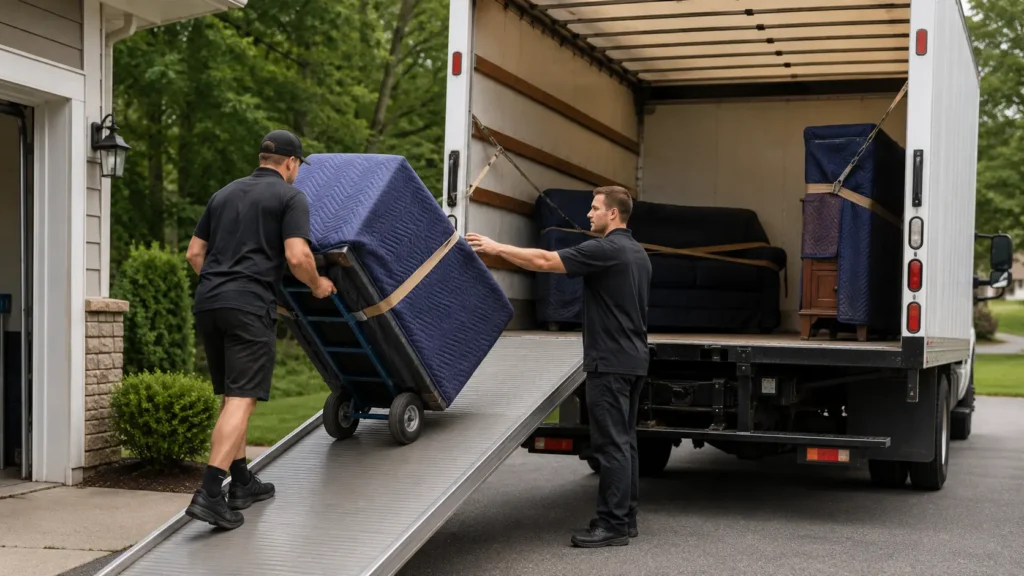
Use a strong and stable ramp when loading heavy furniture into a moving truck.
Check that the ramp is securely connected to the vehicle. The surface should be dry and free from:
- Dirt
- Straps
- Boxes
- Water
- Loose packing material
Do not use a weak board as a ramp. It may bend, slide, or break.
Place the furniture on a dolly or hand truck when the equipment is suitable. Secure the load before rolling it toward the truck.
One person should control the equipment. Another person should guide the furniture and watch the ramp.
Move in a straight line when possible. Do not make sharp turns on the ramp.
In a moving truck, place heavy furniture toward the front of the cargo area. Balance the weight from side to side.
For a trailer or portable storage container, follow the rental company’s loading instructions. Weight placement may be different.
Place moving blankets between furniture pieces. Fill large gaps so the items cannot shift during transport.
Secure heavy furniture to the truck’s anchor points with suitable tie-down straps.
Do not rely on boxes to hold heavy furniture in place.
Keep tall furniture upright when required by its design. Secure it so it cannot tip.
Protect glass, mirrors, and delicate panels separately. Never place heavy furniture on top of them.
Check every strap before driving. Check the load again after traveling a short distance when it is safe to stop.
Should You Move It Yourself or Hire Professionals?
Check both lists before deciding whether the move is safe to handle yourself.
A DIY Move May Be Reasonable When
- The route is level, dry, and clear.
- The furniture is stable and not top-heavy.
- The item can be emptied or taken apart.
- The correct sliders, dolly, or straps are available.
- The equipment supports the full weight.
- Capable helpers can control the load.
- There are no difficult stairs or narrow turns.
- The furniture has no fragile glass or stone parts.
Hire Professional Help When
- The stairs are steep, narrow, curved, or open.
- The furniture is unstable or top-heavy.
- The item has glass, stone, antique, or fragile parts.
- The load exceeds the equipment limit.
- The furniture has no safe grip points.
- The building requires insured movers.
- You do not have enough capable helpers.
- Someone has back, joint, heart, or balance concerns.
Know When to Get Professional Help
Some furniture should not be moved as a do-it-yourself project.
Hire trained or specialist movers for items such as:
- Pianos
- Large safes
- Slate pool tables
- Stone-top tables
- Heavy antiques
- Glass display cabinets
- Large appliances on stairs
- Oversized armoires
- Furniture that must pass through a window or balcony
You should also get help when:
- The route includes steep or narrow stairs
- The furniture has no safe grip points
- The item is unstable or top-heavy
- You cannot estimate its weight
- The furniture cannot be taken apart
- You have too few helpers
- The load exceeds the equipment limit
- Someone has back, joint, heart, or balance concerns
- Your building requires insured movers
- The furniture may damage the property
Moving heavy furniture when you live alone
When you live alone, do not plan a difficult move around the hope that you can handle the item by yourself.
Instead, consider:
- Asking the seller about delivery
- Hiring labor-only movers
- Booking help for pickup and drop-off
- Renting the correct equipment
- Buying furniture that can be assembled inside the room
- Combining several heavy jobs into one appointment
- Asking your building manager for approved movers
- Choosing delivery that includes room placement
Moving a dresser a few feet with sliders is different from carrying a couch upstairs alone.
Only attempt a solo move when:
- The furniture is stable
- The route is level
- There are no stairs
- The item can be controlled without lifting
- The correct sliders or equipment are available
- There is no serious tipping risk
Buying secondhand furniture
Before buying furniture from a local seller:
- Ask for exact measurements
- Confirm whether the item comes apart
- Ask whether the seller offers delivery
- Check whether help is available at pickup
- Measure your vehicle
- Measure your home entrance
- Check all stairs and elevators
- Ask about glass, stone, or fragile parts
Share the full moving details with any paid helper.
Include:
- The item’s size
- The pickup address
- The delivery address
- The number of stairs
- Elevator access
- Parking limits
- The number of workers needed
- Fragile or valuable materials
Choosing moving help
Before hiring a moving company or labor-only service, ask:
- Is the company insured?
- Does the price include stairs?
- Is there a minimum booking time?
- Does the team bring moving equipment?
- Are travel fees included?
- Can they handle specialty items?
- Are extra charges possible?
- Does the service include loading and unloading?
- Will the workers place the furniture inside the room?
Do not choose help based only on the lowest price.
Check:
- Recent reviews
- Insurance
- Services included
- Cancellation terms
- Minimum hours
- Extra fees
- Damage policies
Moving Day Safety Checklist
Review this checklist before moving or lifting heavy furniture.
Before Moving
Before Lifting
Conclusion
Moving heavy furniture often looks easy until the item gets stuck in a doorway, tips near a corner, or scratches the floor. The job becomes even more stressful when you live alone, have limited help, or need to move a couch, dresser, table, or appliance through stairs and narrow halls. You may also worry about hurting your back, damaging a wall, losing part of your security deposit, or choosing the wrong tool for the job.
After researching furniture-moving methods, professional safety guidance, equipment instructions, and real problems shared by renters and homeowners, I found that the hardest part is not always the weight. It is keeping the furniture stable and controlling it through tight spaces. The safest approach is to empty and disassemble the item, measure the full route, protect the floor and walls, and use equipment suited to the furniture and surface. This guide explains how to move heavy furniture safely, which tools to use, and when professional help is the better choice.
Frequently Asked Questions
Can one person move heavy furniture?
One person may be able to slide stable furniture across a level floor after emptying it and using the correct sliders. A person should not carry heavy, tall, unstable, or specialty furniture alone. Stairs normally require proper equipment and capable helpers.
What is the easiest way to move heavy furniture?
The easiest method depends on the route. Use sliders for short moves across a level floor. Use a furniture dolly for stable items on a flat route. Use a secured hand truck for some tall items. Use an appliance dolly for large appliances.
How do you put sliders under heavy furniture?
Empty the furniture first. Slightly lift one corner with a safe grip or a purpose-made furniture lifter. Place the slider fully under the leg or support point. Lower the item slowly. Never place your fingers under unsupported furniture.
Can you move heavy furniture without a dolly?
Some stable furniture can be moved a short distance with sliders or two-person lifting straps. However, do not use improvised methods for stairs, appliances, tall furniture, or very heavy items.
Is it better to push or pull heavy furniture?
Pushing is often easier because you can use your legs and see the direction of travel. Apply force to a strong, lower part of the furniture. Do not push a tall item from the top because it may tip.
Can furniture sliders be used on stairs?
No. Standard furniture sliders are designed for level surfaces. They cannot control speed, direction, or tipping on stairs.
How do you move heavy furniture without scratching hardwood floors?
Clean the floor first. Use clean felt-bottom sliders made for hard floors. Check for dirt under each slider. Use floor runners for longer routes. Do not drag furniture directly across the surface.
How many people are needed to move a couch?
The number depends on the couch’s size, weight, grip points, route, and stairs. A small couch on a level path may need two capable people. Large couches, narrow stairs, and difficult turns may require more help or professional movers.
How do you move furniture into an apartment?
Measure the furniture, entrance, hallways, stairs, and elevator. Check the building’s moving rules. Reserve the elevator or loading area when required. Use padding to protect walls and doors. Hire help if stairs or tight turns make the move unsafe.
How do you pick up furniture from an online seller?
Ask for the exact size and weight before pickup. Confirm whether the furniture can be taken apart. Measure your vehicle and home entrance. Arrange enough helpers and bring suitable straps, blankets, and moving equipment.
Should you rent equipment or hire movers?
Rent equipment when the item is stable, the route is simple, and capable helpers are available. Hire movers when stairs, fragile materials, large appliances, specialty furniture, or limited physical ability make the move unsafe.

Muhammad Muaz
Muhammad Muaz shares practical cleaning, home care, improvement and everyday living guides for Urban Home Guide readers.
Related Home Guides