
What is Contract Grade Furniture Really Means
A sofa or chair can look sturdy under showroom lights. Yet daily use exposes weak frames, loose joints, worn fabric, and poor finishes. If you are asking what is contract…

A sofa or chair can look sturdy under showroom lights. Yet daily use exposes weak frames, loose joints, worn fabric, and poor finishes. If you are asking what is contract grade furniture, you are likely comparing a higher-priced item with a standard residential option. You may also be trying to avoid furniture that wears out too soon.
Contract-grade furniture is made for repeated use in commercial, public, or shared spaces. It often uses stronger construction, durable finishes, and performance-tested materials. However, the label does not point to one universal certification. A credible product should show what was tested, which standard was used, and whether its warranty covers the intended use.
That difference matters at home. Contract-grade furniture can suit a busy family room, rental, dining space, or home office. Still, it may cost more, weigh more, or take longer to arrive. The right choice depends on the room and the problem you need to solve.
What is contract grade furniture?
Contract-grade furniture is designed for frequent use in commercial, institutional, or public settings. These spaces include offices, hotels, restaurants, healthcare facilities, schools, airports, and waiting areas.
The term usually suggests more demanding performance than typical household furniture.
However, “contract grade” does not mean every product follows one identical rule. A task chair, lounge seat, table, and storage unit face different stresses. Therefore, different product categories may use different tests.
The label also does not guarantee comfort, style, or long life everywhere.
My view is simple: treat contract grade as a claim that needs proof. The phrase can be meaningful, but only when the manufacturer explains what supports it.
Why Public-Space Furniture Often Feels More Durable
Furniture in public spaces serves more people for longer periods. It faces repeated sitting, shifting loads, frequent cleaning, and less careful handling. As a result, manufacturers may use stronger internal parts and more resistant surfaces.
Those differences are not always visible. Two chairs can share the same shape and fabric color. Yet one may have reinforced joints, tested casters, replaceable parts, and upholstery selected for high traffic.
Still, heavy furniture is not automatically contract grade. A solid feel proves little by itself. Product documents matter more than appearance.
Contract Grade Furniture Standards and Verification
The phrase “contract grade” can sound like an official seal. In the United States, no single test covers every furniture type. Instead, standards apply to specific product categories or materials.
ANSI and BIFMA are central names in commercial furniture testing. BIFMA maintains separate safety and performance standards for office chairs, lounge seating, desks, tables, storage units, and educational seating.
A chair may face stability, repeated-load, caster, swivel, or tilt tests. Tables and storage units face different risks.
Contract textiles have separate concerns. ACT guidelines cover abrasion, flammability, crocking, lightfastness, and physical properties. Yet suitability still depends on the fabric, application, and environment.
Wyzenbeek and Martindale results are not directly interchangeable. Extreme abrasion scores also do not guarantee a longer service life.
Before accepting a contract-grade claim, ask:
- Which exact standard was used?
- Was the exact model and base configuration tested?
- Did an accredited laboratory perform the test?
- Does the warranty cover commercial or high-use conditions?
- What weight capacity was tested?
- Are upholstery and finish results available?
- Which cleaning products are approved?
- Can damaged parts be replaced?
Documentation should match the item you are buying. A test on one chair base may not cover every alternate base. Likewise, a fabric result does not prove the frame is durable. What matters most is the complete configuration.
How Contract-Grade Furniture Is Different
Contract-grade furniture differs mainly through intended use. Residential furniture may place more weight on softness, decorative details, convenience, or price.
Stronger Internal Construction
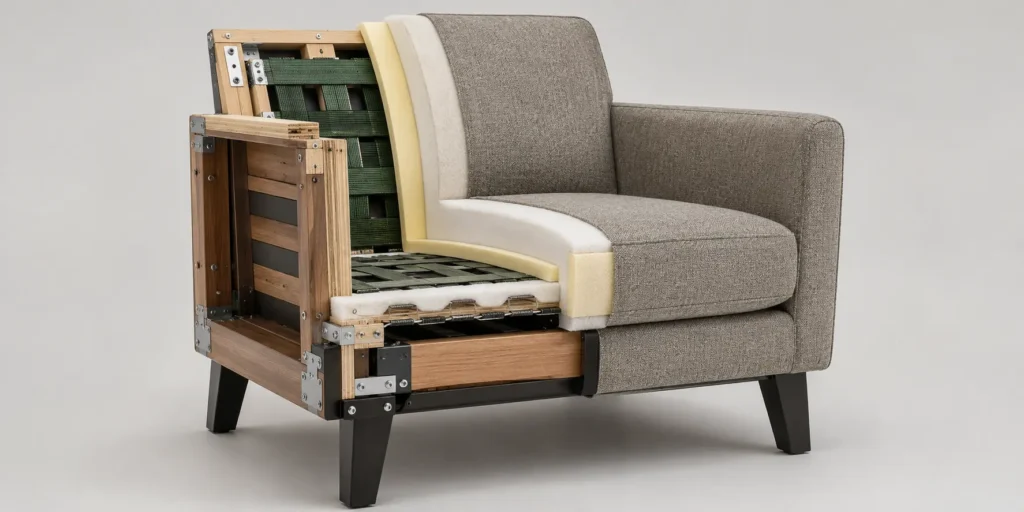
The most important differences are often hidden. Contract furniture may use reinforced frames, stronger joints, heavy-duty fasteners, stable bases, commercial hardware, or replaceable components.
Furniture often fails at stress points. Therefore, appearance alone cannot show how a product will age.
Materials may include hardwood, steel, aluminum, laminate, veneer, powder-coated metal, or high-density foam. However, a material name alone proves little.
A practical buyer should look beyond the fabric swatch. Ask how the frame is built, how the legs attach, and whether parts can be serviced. That sounds obvious, but product pages often focus on what you can see.
Performance-Tested Upholstery
Commercial upholstery must handle more than rubbing. It may face cleaning, spills, color transfer, fading, seam stress, and disinfectants.
Abrasion testing can still be useful. Wyzenbeek and Martindale methods help compare fabrics tested under the same method. However, their results should not be mixed or treated as a complete durability score.
ACT guidelines also consider flammability, crocking, lightfastness, and physical properties.
For a family home or rental, cleaning compatibility deserves close attention. A fabric can resist wear yet react badly to an unsuitable cleaner. Therefore, check approved cleaning instructions before choosing a color or texture.
Fire and Safety Requirements
Fire safety and contract durability are related, but they are not the same. A product can meet a flammability requirement without being suitable for heavy commercial use.
In the United States, upholstered furniture may fall under federal smolder-resistance requirements. Projects may also face local or occupancy-specific rules. However, one fire rule does not prove structural strength, cleanability, or durability.
Therefore, do not treat “fire compliant” as a complete contract-grade claim. Ask which requirement applies and what other testing supports the product.
Commercial Furniture Versus Residential Furniture
Commercial and residential furniture solve different problems. Neither is automatically better everywhere.
| Comparison point | Contract or commercial furniture | Residential furniture |
|---|---|---|
| Intended use | Frequent, shared, or high-traffic use | Typical household use |
| Construction | Often reinforced for repeated service | Varies by brand and price |
| Testing | May use product-specific standards | May lack commercial test documents |
| Upholstery | Often chosen for wear and cleaning | Often chosen for comfort and appearance |
| Customization | Can offer commercial finishes and fabrics | Often limited to retail options |
| Lead time | May be made to order | Often stocked |
| Price | Often carries a higher upfront cost | Available across a wider range |
| Warranty | May include commercial terms | Usually written for home use |
Durability, Design, and Application
Durability should match the room, not the label. A waiting area, restaurant, or school places different demands on furniture than a guest bedroom.
Likewise, a family dining area may need more resilience than a formal room used occasionally. Under-specifying can lead to early damage. Yet over-specifying can waste money and limit comfort or style.
Contract furniture does not always look institutional. Many products use residential forms, colors, and textures. Still, some designs favor consistency, modularity, or easy maintenance over plushness.
Commercial suppliers may offer custom finishes, upholstery choices, moisture barriers, or customer-supplied materials. However, those options may increase lead time.
Pricing, Warranties, and Ownership Cost
Contract products may cost more because they use stronger construction, tested parts, and commercial materials. Some are also made to order. Therefore, the buying process can feel different from standard retail shopping.
A useful cost comparison includes freight, installation, maintenance, repair, and replacement.
Still, contract grade creates value only when its added performance matches your needs. A quiet bedroom does not need the same specification as a busy waiting area.
Warranty terms deserve close attention. Confirm whether the warranty covers residential, commercial, or rental use. Also check upholstery, finishes, hardware, and replacement parts.
Benefits of Contract-Grade Furniture at Home
Contract-grade furniture can be a smart choice when a home behaves like a high-use environment.
A busy family room, furnished rental, or heavily used home office may benefit from stronger frames and cleanable surfaces.

Possible benefits include:
- Construction designed for repeated use
- Upholstery selected around performance needs
- Clearer product testing or documentation
- Finishes made for frequent cleaning
- Commercial warranty options
- Greater choice in fabrics and finishes
- Access to replacement components
If a previous item failed, identify how it failed. Maybe the base loosened, the cushion lost support, or the finish wore badly. Then look for documented performance in that area.
Downsides of Contract-Grade Furniture
Contract grade is not the right answer for every home. The higher specification can bring trade-offs.
The upfront price may be higher. Freight and installation may also cost more. Some products are heavier, which makes moving them less convenient.
Customized pieces may bring longer lead times and stricter return terms.
Comfort can differ too. A product built for support and repeated use may not feel as soft as a residential alternative. Scale can also become an issue in a smaller room.
There is a risk of paying for performance you will never use. A decorative chair in a quiet bedroom does not face restaurant-level traffic. In that case, a well-built residential piece may be more practical.
I would not recommend buying contract grade simply because it sounds stronger. Buy it when its documented strengths solve a specific problem.
Should You Use Contract-Grade Furniture at Home?
The decision becomes easier when you focus on use rather than labels.
Start with the room. How often is the furniture used? Who shares it? Does it need frequent cleaning? Have similar pieces failed before?
Next, consider how long you expect to keep the item. Higher cost may make sense when repairability matters.
Then verify the claim. Look for the exact testing standard, model configuration, cleaning instructions, warranty terms, and service options. A clear product sheet is more useful than a bold badge.
Contract Grade Makes Sense When
- The room gets frequent daily use
- Several people share the furniture
- Children or pets increase wear
- The item will be used in a rental
- Cleaning happens often
- Previous furniture failed too soon
- Replacement parts matter
- Test data matches the intended use
Residential Furniture Is Enough When
- The room is used lightly
- Comfort or decorative detail matters more
- The furniture is temporary
- Commercial freight or lead times create problems
- The product already has strong construction
- The contract-grade claim lacks useful documentation
A non-contract product is not automatically low quality. The better option is the one that fits your room.
A Practical Rule for Choosing
Buy for the level of use, not for the status of the label.
First, identify what is most likely to fail. It may be the frame, upholstery, finish, hardware, or cushion support. Then look for documented performance in that area.
Finally, avoid paying for features that do not solve your problem. Contract grade has value when it is specific, verified, and relevant.
Conclusion
Contract-grade furniture deserves neither blind trust nor automatic dismissal. My view is that the label matters only when clear details support it.
Look past the product name. Check the construction, material tests, cleaning guidance, warranty, and exact configuration. Then compare those facts with the demands of your room.
For a heavily used home, rental, or workspace, documented contract performance can justify the added cost. For a quiet room, it may solve a problem you do not have. Let the evidence carry more weight than the badge.
FAQs
Is contract-grade furniture the same as commercial-grade furniture?
The terms are often used in similar ways. Both usually describe furniture intended for frequent use in commercial, institutional, or shared environments.
Is contract-grade furniture always better?
No. It may offer stronger performance for heavy use, but a well-made residential piece can suit a lightly used home better.
Is “contract grade” an official certification?
Not by itself. The claim becomes more useful when it includes product-specific standards, test reports, registry listings, and suitable warranty terms.
Can contract-grade furniture be used at home?
Yes. It can suit busy family rooms, rentals, dining spaces, and home offices when its size, comfort, price, and design fit.
Does a high abrasion score guarantee durable upholstery?
No. Abrasion is only one factor, and Wyzenbeek and Martindale results are not directly comparable. Cleaning, seams, light exposure, and actual use also matter.

Muhammad Muaz
Muhammad Muaz shares practical cleaning, home care, improvement and everyday living guides for Urban Home Guide readers.
Related Home Guides